
The business behind the build.
Melissa Eisenbrandt runs Royal Coaching Colorado, a six-figure leadership coaching business she operates on her own. She prepped every session by hand, onboarded each new client from scratch, wrote her own follow-ups, and kept her ICF hours in a spreadsheet going back to 2015. We spent time mapping her actual week, then built a full back-office system around the way she already works. It runs her session prep, her onboarding, her follow-ups, her hour logging, and a command center she checks each morning.
Hear directly from Melissa Eisenbrandt, Royal Coaching Colorado.
The work around the work.
Melissa's coaching was never the problem. It was everything around it. Once the business hit six figures, the back office had quietly turned into a second full-time job. She prepped every session by hand, onboarded each new client from scratch, wrote every follow-up herself, and tracked her ICF credential hours in a spreadsheet she had kept since 2015.
When we sat down and went through her week hour by hour, the pattern was obvious. The admin was growing faster than the coaching. She had the demand to take on more clients and no room to actually do it, because every new client meant more unpaid work stacked on top of the real work.
She had even tried generic AI to move faster. It backfired. The drafts came back in a format she couldn't use, and cleaning them up took longer than starting from a blank page, so she quit using it.
It's all weird to edit… it's taking more time to fix the formatting than to just do it myself.Melissa Eisenbrandt
Tools that cost more time than they saved
Her AI-drafted session skeletons came out 'all weird to edit.' She'd give up on them because fixing the formatting took longer than writing from scratch.
ICF hours trapped in a spreadsheet
Individual hours on one tab, group hours on another. A sheet she'd kept by hand since 2015, updated after every single session, with her whole credential progression riding on it.
Every client onboarded from scratch
No system for it. Welcome, resources, portal setup, and follow-ups were all done by hand every time, in whatever hours were left after coaching.
A system around the way they work.
We didn't hand Melissa another tool to go learn. We built a private system that sits around her exact workflow and writes in her voice, so the admin layer mostly disappears and she's left with the part only she can do. Here's what actually got built.
A brief before every call
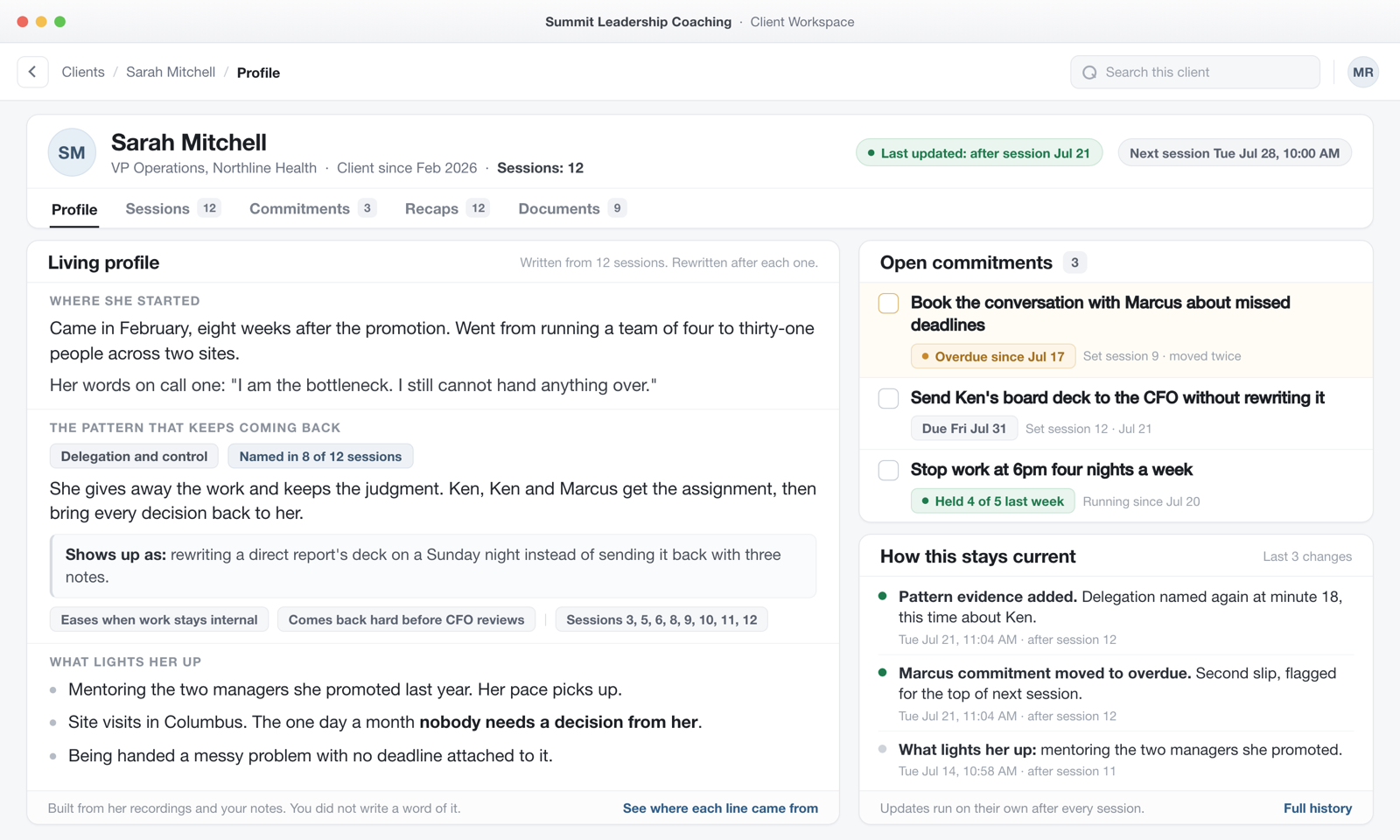
Before each session she gets a short brief on who she's about to talk to: what happened last time, what they committed to, and what's still open. It's pulled from that client's whole history, so she walks in ready without reading back through months of notes.
Zoom transcripts that file themselves to the right client
Every session gets recorded, transcribed, and filed under the correct client on its own. No exporting, no copy-paste, no wondering which folder it belongs in. The notes are just there when the call ends.
Follow-ups written in her voice
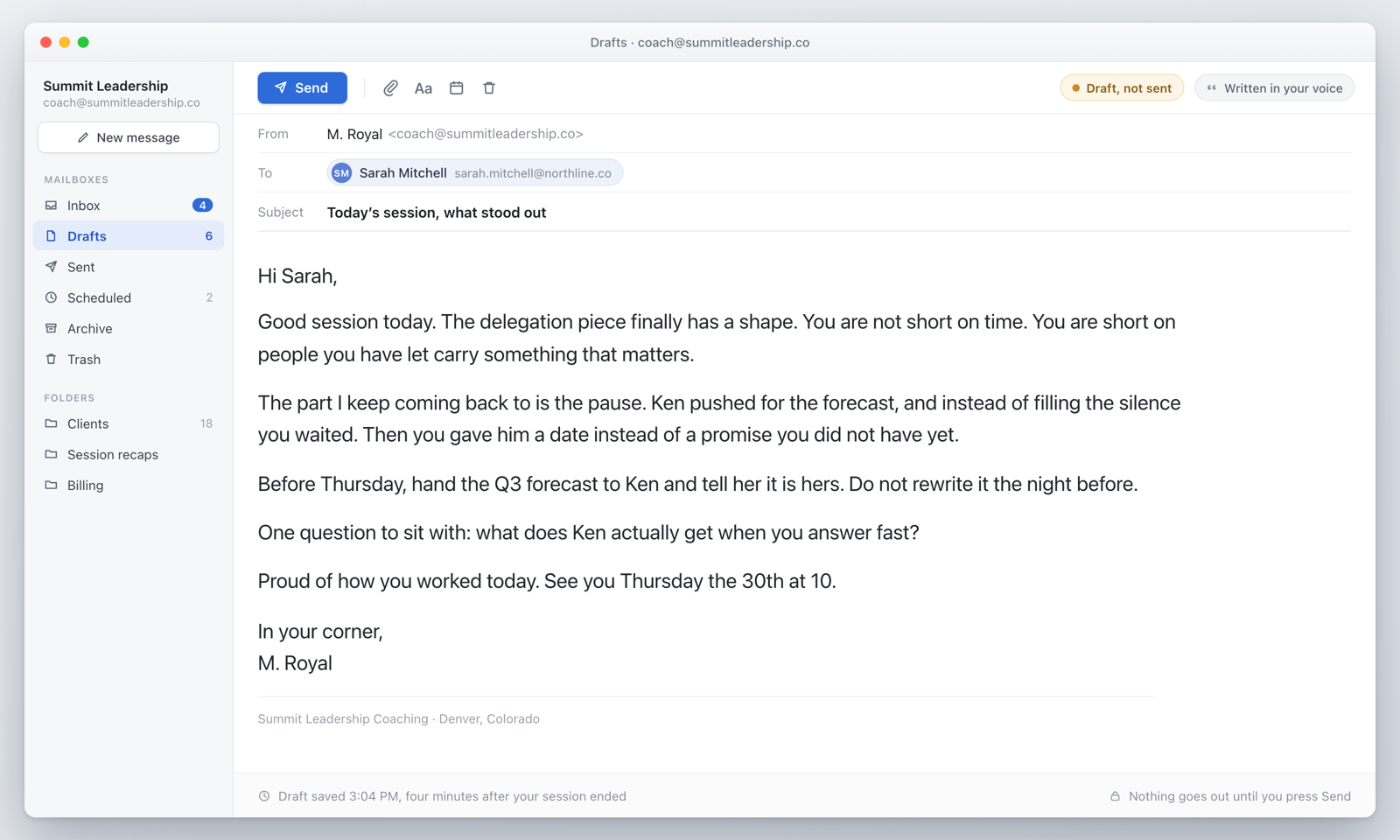
Right after a session she gets an email that the notes are ready. The follow-up is already drafted, in her voice, from what was actually said on the call. She reads it, changes anything she wants, and sends. Nothing goes out without her.
Commitments tracked between sessions
What a client says they'll do gets tracked, so it doesn't fall through the gap between one session and the next. She can see what's open per client instead of carrying it around in her head.
ICF hours logged in about five seconds
She picks the client, picks 45 or 90 minutes, and hits save. It writes straight into her ICF sheet, individual and group kept separate the way the credential needs, instead of the old two-tab hand-entry.
Onboarding that runs itself
A new client kicks off the welcome, the resources, and their portal automatically. Same first impression every time, none of it set up by hand.
A private portal for each client
Every client gets their own space for their resources and materials, created for them when they come on. It's there if they want it and never something Melissa has to build.
An assistant she can just ask
There's a chatbot wired into the whole business. She can ask it something like what she covered with a client last month, or who hasn't rebooked, and get an answer back instead of digging through files.
One place to run the day
A command center with today's sessions, who needs attention, and whatever's waiting on her approval, all in one view instead of five open tabs.
Human-in-the-loop, and hers
The drafts reflect her voice, and she reviews client communications before sending. The system was built around her business.
More room for the coaching.
Melissa stopped touching most of the back office. She wakes up to a briefing, her sessions prep themselves, new clients onboard on their own, and follow-ups go out on time. She reports saving 20 hours per week. This is her reported experience, not a measured average or a promise of the same result for every client.
hours saved per week, client-reported
to log an ICF hour (was minutes)
It's magical. It took me like 5 seconds. Holy moly.Melissa Eisenbrandt · on logging a coaching hour